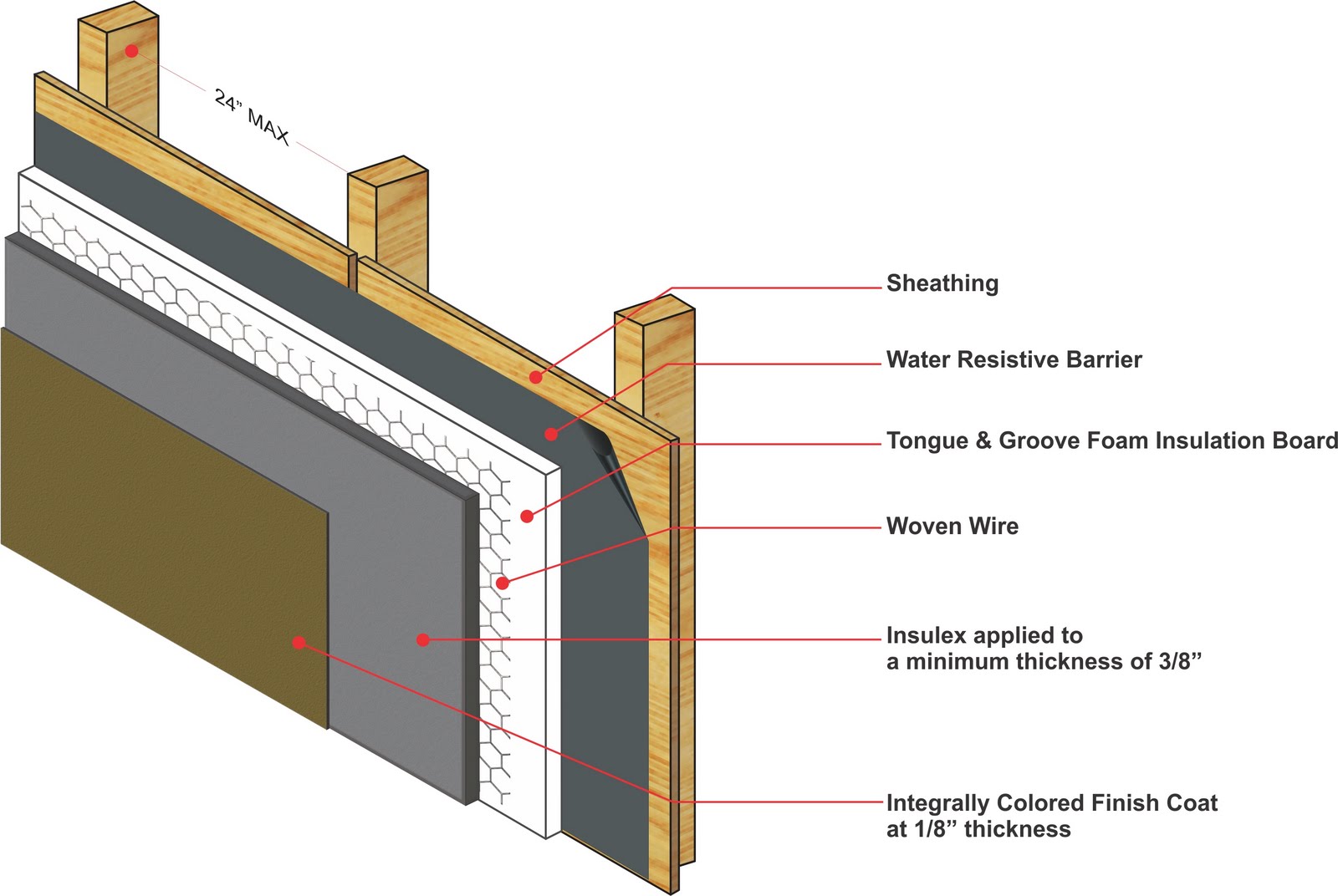
The new Title 24 rules for higher energy efficiency in homes and buildings will have builders scrambling to find cost effective means of reaching these new values. There are 16 different climate zones that have different requirements but any building with steel studs will be affected as a result of “thermal bridging”. This is the transference of energy from inside the structure to out through the more dense material. In many climate zones the home builder will have to find ways to better insulate their homes and at the same time stay competitive and give the potential home buyer more home for less money so the banks will loan money for them. One way to do this is using foam on the entire outside of the home. This was called “one-coat” Stucco in the 1980’s but is now referred to as “continuous insulation systems”. This system uses a different wire over the foam sheets that is slightly thinner and has less “furring” to hold less material or cement in the wire. Typical 3 coat systems have 7/8 inch of material to make up the wall where “CI” systems use about a ½”. The foam not only helps insulate the house but serves as another barrier to water intrusion. The foam absorbs some movement and therefore it could be argued that cracking would be lessened. This is probably how the home builder is going to address the increased requirements in the future as the other solutions can be quite expensive. They can add solar panels; use more energy efficient doors and windows. They can use better HVAC systems (heating and air conditioning). However these methods are more costly. The one thing that the consumer must be aware however is the potential for a soft wall or increased cracking because of overloading of sand in the Cement Product. The manufacturers produce these products as concentrates and the plastering contractor uses sand that is brought to the job-site separately. Sand is less expensive than the one-coat concentrate so more sand added saves money. The issue then is how to control how much sand goes into each sack of material and ultimately on our homes. The more stringent waste water and run-off requirements may solve this problem for us. The State of California is becoming more stringent in dictating what goes into our storm drains and run-off. Job sites are now required to have catch basins for cement effluent and piles of sand are increasingly not allowed because of what they add to waste run-off. Pre-sanded products will more than likely be required and will start in communities that have more stringent rules regarding raw materials set ups. Manufacturers’ can use the proper amounts of sand in their products as well as the right type and purity of material. This also can reduce cracking and make sure the strength of the wall is maximized. Other markets such as Las Vegas, Phoenix and Central California have utilized this method of building for many years. I think that with proper controls we can adopt this method in Southern California without the litigation that some of these other markets have been subject to.
Monday, April 11, 2011
Monday, March 7, 2011
Cement And Natural Materials
A few years ago we heard of “Feng Shui”. This is the eastern philosophy that things must be aligned in a certain manner to be pleasing and comfortable. I think that natural materials and colors used in nature make us feel more comfortable and create spaces and structures that are most pleasing to the senses. Cement, lime, stone, and masonry are basic materials “from the earth”. I believe the use of these building materials have become more popular over the last decade because of our developing knowledge that these products help our psyche. When I am asked about painting stucco I usually comment on vapor permeability and how paint can trap moisture. When stucco is painted it also shortens the product life cycle. Stucco can last many years with very little maintenance. When we paint stucco it only lasts as long as the paint. The other reason not to paint is due to aesthetics not functional. Since real stucco is made of sand, cement, lime, and natural iron oxide pigments our brain is more comfortable with the finish than paint, siding, or synthetics. When you think of it most natural products take less upkeep than synthetics by their very nature. I have also seen a trend towards natural colors in stucco. Deep rich hues are most desirable but the most popular colors are earth tones. Deep oranges and yellows, rust colors, and dark browns are most widely used on high end custom homes. Lime is also more often used now and I believe it is for the same reason. Lime was first used as a binder for building long before cement was discovered; mixed with volcanic ash lime would harden and was used in much of the building in ancient times. Lime is a wonderful material having incredible character as it cures and ages. Lime is slaked to make a workable material and then used in mortar and colored for use on interior and exterior walls and ceilings. Visit the Vero website, www.vero-rialto.com to read more on the lime process that enables this material to be so versatile.
I believe that stucco was sort of thrusted on us by the building community because it was so inexpensive. However, with improvements in materials, basecoats, and workmanship we see smooth colored materials both cement and lime based being some of the most beautiful finishes available. It is fortunate that the most beautiful materials are also naturally made from abundant resources and with the right design intent can make our structures more beautiful and functional than ever.
Tuesday, February 8, 2011
Staining
Plaster and stucco are porous materials and therefore susceptible to staining. Stains come from anything that can leach into the plaster through moisture and water. The most common being the planters and dirt that we pile up against the bottom of our homes. Code dictates the bottom of the plaster (the termination screed) should be 4 inches above softscape (planter’s, dirt, the ground, etc.) and 2 inches above hardscape (brick paving, concrete, etc.). Moisture carries the dirt and organic material into the stucco. That is why you can’t clean the stucco; the staining is not on the surface it is in the material. Another common place for staining to occur is from decks and roofs particularly where there is no overhang or gutters to divert water from washing down onto the face of the stucco. The water again carries the dirt and is absorbed into the plaster. There are ways to prevent this: as mentioned, try to divert water away from the plaster walls. If there are planters right up against the house you can pull back the dirt and treat the bottom of the structure with a waterproofing product like Super Blockade. This is a cementitious product that lasts many years and prevents absorption of moisture. You can also seal the stucco with a good penetrating sealer like MicroSeal II. This chemical prevents moisture from going into the wall but still allows the wall to breath. Keep in mind, these long lasting sealers penetrate and will only protect the surface if they are built up to impregnate the pours all the way to the surface. The primary function of a penetrating sealer is to keep water out of the wall cavity. Most damage is done if water is allowed into the wall. Surface moisture is typically an aesthetic problem. Of course, over time, water will degrade the surface through efflorescence and delimitation. Since the problem is already present we should discuss how to solve it. Paint is not the answer as paint disrupts the vapor from leaving the wall and has to be re-applied regularly. Fog coat is the product that is supposed to be used for stucco. It is cement paint and can be spray applied to make the wall look new again. Following this process a sealer should be applied to keep the problem from re-occurring.
![]() |
| Microseal II application - Dublin City Hall Dublin, CA |
Tuesday, February 1, 2011
Shrinkage- the “other cracking”
The two types of stucco cracks are structural and shrinkage. The structural are the ones we see most because they are large and very common. Shrinkage cracks are the ones that look like a honey comb or spider web cracking on smooth coat stucco. These are typically so small they are not open and can’t be seen from more than five feet away. People still ask and worry that they will somehow degrade the finish over time. The problem is only aesthetic. They will actually lessen over time as the stucco cures and hydrates. I tell homeowners this is a typical condition and should be expected to some degree. Shrinkage cracks are caused by moisture or water leaving the stucco matrix thereby leaving small voids. They can be lessened by tooling the stucco on the last pass at the exact right time. As any cement based material begins to set up it needs to be troweled at the precise time that there is still some moisture in the material at the surface. Not enough moisture and the trowel will cause friction and “burn” the surface causing darker areas. Too much moisture and the surface will not close and be done. You can imagine how this may be easily done in the lab on a small panel of stucco. Think about how difficult this timing becomes on a building with multiple levels, elevations, ground conditions, and limited man power. Then add weather variations and you can see how hard it is to tool areas when the conditions are perfect. In hot, dry, or windy conditions the stucco will dry very quickly. The tradesman will carry a misting bottle to re-hydrate the surface to aid in finishing. On a cool, cloudy day, or on the north or shady side of a building it may take hours before the surface is ready for the final tooling. This is why a certain amount of shrinkage cracking can be expected and is not a problem. As homeowners we can do something to help this condition. Moist curing is the process of adding water to the under coats of cement and sand in the plaster process. This slows the curing process and makes a stronger wall. Typically the contractor will schedule moist curing for the scratch and brown coats but not the final color coat. This is because on the color coat improper moist curing can lead to color problems. That is, if more water is put on one area than another it will dry longer and therefore darker. It is critical to add the same amount of water to the same panel. If one side is in the shade and never receives sun then minor moist curing is needed. The panels that will dry quickly should be moist cured with the most water. If the homeowner knows to do this then he or she will probably care more about doing a proper job. It is better to not moist cure the final coat if care is not taken to do the job right. Adding water keeps the moisture in and the shrinkage cracks from appearing. So the next time you start seeing the small little cracks in a new wall either ask when you can add water to the wall or stand more than five feet from the area.
Monday, January 10, 2011
Efflorescence
This is the second rainiest December in recorded history in Southern California. For those of us in the stucco business lots of rain can only mean one thing: EFFLORESCENCE!
This is the white powdery material we see on concrete, masonry, stucco and other substrates that are naturally high in alkaline. Usually about a week following the rains I get quite a few calls from builders and homeowners letting me know that “the lime is coming out of the stucco”! I patiently explain that these are naturally occurring mineral salts that are present in plaster, cement, stucco, mortar, stone, soil, water, and many other materials used in construction. In some cases the efflorescence can manifest itself as a “bloom” of white calcium carbonate and have a crust. The water soluble salts liquefy and as the wall dries the water migrates to the surface carrying the salts. The water turns to vapor and evaporates leaving the salts on the surface in the form of efflorescence. We see it most often in new construction where the salts are in higher concentrations. But efflorescence can occur over time as long as the salts are present and the conditions exist for them to migrate to the surface. Slower evaporation also tends to allow more salts to come to the surface and obviously large amounts of rain exacerbate the condition. The good news is that these salts can be neutralized. Since these salts are by nature extremely high PH it is logical that a low PH solution (an acid) should be used to neutralize it. On a smooth wall or masonry you can use a soft brush and a mild solution of white vinegar and water to kill it. On tougher staining or textures that can be damaged by scrubbing then a stronger acid solution can be used. Be extremely careful however, acid can etch glass, kill plants and is very caustic and hazardous to use. One method for removal is to dry brush the calcium off and then flush the area with water. This seems counter intuitive to add more water but since there is a finite amount of salt it does work. After cleaning a sealer can be used to stop water. Merlex’s Micro Seal is an excellent chemical for stopping water. If the water cannot get into the wall it can’t carry the salts back out. So the next time it rains just get out the vinegar and don’t blame it on the lime!
Tuesday, January 4, 2011
Cracking In Exterior Stucco
Having been in the construction industry for over thirty years and at Merlex for close to eighteen I am usually asked the same questions over and over. Through the years I have written letters explaining certain conditions and tend to use the same ones for similar circumstances. There are published reports and industry associations from which I have drawn much information and technical data. I have sold lath and plaster, drywall, metal studs, masonry and related tools and aggregates that have given me much experience in the construction of walls and ceilings. I have consulted on structural issues, fire ratings, and water intrusion problems. I now feel uniquely suited to answer questions and offer solutions about frequently asked questions regarding stucco, plaster systems and the building envelope. I hope that I can have some lively discussions and learn a few things both locally and within other regions about stucco and related products and issues.
Topic #1 Cracking in exterior stucco
The single most discussed topic in Portland cement stucco is cracking. I have spent countless hours and many thousands of miles looking at cracks which don’t seem to change much over the years.
No one can guess how much the stucco will crack in your home, building etc. There are many reasons for cracking none having anything to do with the quality of material, level of workmanship or knowledge of the builder. It does have everything to do with how much the structure moves. All the variables for structural movement are in play including geological conditions, wind shear, movement and shrinkage of framing members, weight on the building envelope (walls) seismic activity and any other cause of stress to the building. It is advisable to discuss this at length with your structural engineer, architect and general contractor before proceeding with the plaster and stucco. There are certainly some technological advances in the plaster system that can reduce (not eliminate) the incidence of structural cracking. The base and mesh system is the newest and most effective solution to significantly reduce the incidence of cracking. This is an additional coat of material consisting of a polymer modified base coat with an embedded fiberglass mesh for added reinforcement. The benefit is twofold: The first is the modification of the additional cement with polymer to allow for some movement or elasticity in the material. The second part of the system is the mesh that works as a slip joint to arrest cracks that emanate from some underlying stress. You can find more specific information on the Merlex site on the technical bulletin for Basex and the Basex frequently asked questions sheet.
I hope that I hear from industry experts, product reps, or other areas with some novel solutions to this old problem.
Subscribe to:
Posts (Atom)